


Startup vs Traditional Business: What Should You Build in 2026?
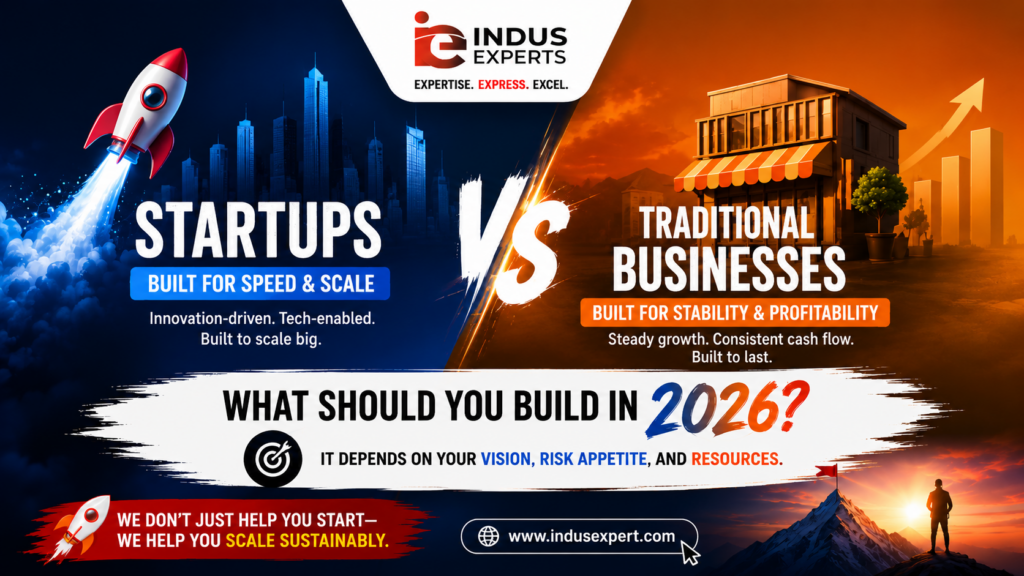
The business landscape in 2026 is evolving faster than ever. Entrepreneurs today are no longer limited to traditional brick-and-mortar businesses. With rapid advancements in technology, digital transformation, artificial intelligence, and global connectivity, many aspiring founders are now choosing between building a startup or establishing a traditional business.
While both models offer opportunities for growth and profitability, they differ significantly in structure, scalability, funding, risk, and long-term vision. Understanding these differences is essential before deciding which path aligns with your goals, resources, and market opportunities.
Professional advisory firms like Indus Experts, operating in the professional services and financial consulting sector, emphasize that the right business structure depends on factors such as scalability, compliance requirements, funding strategy, and operational objectives. The firm provides services including corporate legal advisory, IPO support, global incorporation, governance, due diligence, and financial consulting for businesses across industries
Understanding the Difference Between a Startup and a Traditional Business
Although both are businesses, their approach and objectives are fundamentally different.
What Is a Startup?
A startup is typically designed to solve a scalable problem through innovation, technology, or disruption. Startups aim for rapid growth and often seek external funding from angel investors, venture capitalists, or institutional investors.
Key characteristics of startups include:
- Innovation-driven business models
- High scalability potential
- Technology-focused operations
- Fast growth objectives
- Investor-backed expansion
- Higher risk with potentially higher rewards
Examples include SaaS platforms, fintech companies, AI businesses, health-tech ventures, and digital marketplaces.
What Is a Traditional Business?
A traditional business focuses on stable operations, steady revenue generation, and long-term sustainability. These businesses are generally self-funded or financed through loans rather than venture capital.
Traditional businesses commonly include:
- Retail stores
- Manufacturing businesses
- Restaurants and cafes
- Trading firms
- Service providers
- Local businesses
Their growth is usually gradual and focused on profitability rather than aggressive scaling.
Why Startups Are Dominating in 2026
The startup ecosystem continues to expand in 2026 due to several global and technological trends.
1. Technology Has Reduced Entry Barriers
Cloud computing, AI tools, automation, and digital platforms have made it easier and cheaper to launch scalable businesses. Entrepreneurs can now reach global audiences with minimal infrastructure.
2. Investor Interest in Innovation
Investors are actively seeking disruptive ideas in sectors such as:
- Artificial Intelligence
- FinTech
- ClimateTech
- HealthTech
- SaaS
- EdTech
- Renewable Energy
This has increased funding opportunities for scalable startups.
3. Global Market Access
Digital businesses can operate internationally from day one. Startups are no longer limited by geography, allowing founders to scale globally much faster.
4. Flexible Business Models
Subscription models, digital marketplaces, remote operations, and platform-based services allow startups to adapt quickly to changing market trends.
Why Traditional Businesses Still Matter
Despite the rise of startups, traditional businesses remain highly relevant and profitable in 2026.
1. Stability and Predictability
Traditional businesses often provide consistent cash flow and lower operational uncertainty compared to startups.
2. Lower Dependency on Investors
Most traditional businesses are independently controlled, reducing pressure from external investors and shareholder expectations.
3. Strong Local Demand
Many industries such as food services, construction, logistics, healthcare, and retail continue to rely heavily on traditional business models.
4. Easier Operational Understanding
Traditional businesses generally follow proven systems and established market demand, making them easier to manage for first-time entrepreneurs.
Which Business Model Is Better in 2026?
The answer depends entirely on your goals, resources, expertise, and risk appetite.
Choose a Startup If:
- You want rapid growth
- You are solving a scalable problem
- You are comfortable with higher risk
- You aim to attract investors
- You have a technology-driven idea
- You want global market reach
Choose a Traditional Business If:
- You prefer stable income
- You want lower financial risk
- You value operational control
- You are targeting local markets
- You prefer gradual expansion
- You want faster profitability
The Rise of Hybrid Business Models
Interestingly, 2026 is also witnessing the growth of hybrid businesses that combine the strengths of both models.
For example:
- Traditional businesses using AI and automation
- Retail businesses building digital platforms
- Manufacturing firms adopting SaaS-based operations
- Professional service firms leveraging technology for scalability
Many companies are blending innovation with operational stability to create sustainable growth models.
Legal and Compliance Considerations in 2026
Whether building a startup or a traditional business, legal structuring and compliance are becoming increasingly important.
Businesses today must address:
- Company incorporation
- Tax planning
- Regulatory compliance
- Intellectual property protection
- Corporate governance
- Risk assurance
- Financial transparency
- Investor readiness
Firms like Indus Experts help businesses navigate these complexities through services such as global incorporation, corporate governance, due diligence, legal advisory, IPO consulting, and compliance automation.
The company brings together professionals including Chartered Accountants, Company Secretaries, lawyers, and financial experts to support businesses through every stage of growth.
Important Questions to Ask Before Choosing
Before deciding between a startup and a traditional business, entrepreneurs should ask:
- What problem am I solving?
- How scalable is my business idea?
- Am I comfortable with financial uncertainty?
- Do I want external investors?
- How quickly do I want to grow?
- What operational model suits my strengths?
- What are the compliance and regulatory requirements?
Answering these questions honestly can help founders choose the right path.
Conclusion
In 2026, both startups and traditional businesses offer powerful opportunities for entrepreneurs. Startups provide speed, innovation, and scalability, while traditional businesses offer stability, predictable growth, and operational control.
There is no universally correct choice. The best business model depends on the entrepreneur’s vision, risk tolerance, industry knowledge, and long-term goals.
What matters most is building a legally compliant, financially structured, and strategically planned business that can adapt to changing market conditions. Entrepreneurs who combine innovation with strong governance and operational discipline will be best positioned for long-term success in the evolving business landscape.