


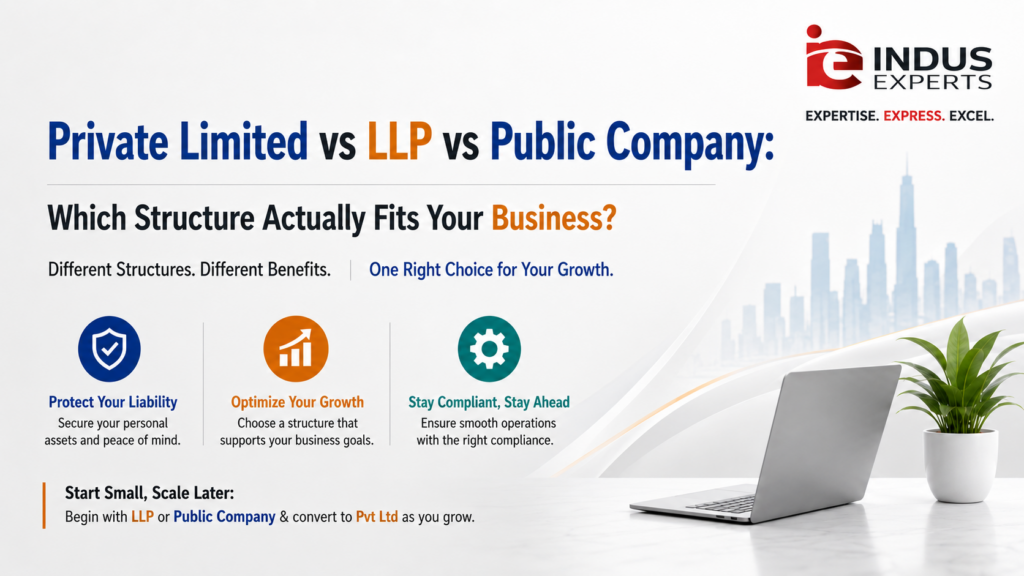
Private Limited vs LLP vs Public Company — Which Structure Actually Fits Your Business?
Starting a business is exciting, but choosing the right legal structure is one of the most important decisions an entrepreneur can make. In India, the most common business structures for growing enterprises are Private Limited Company, Limited Liability Partnership (LLP), and Public Company. Each structure offers different advantages depending on your business goals, funding plans, compliance capacity, and long-term expansion strategy.
Professional advisory firms like Indus Experts, operating in the professional services and financial consulting sector, help businesses choose the right structure through incorporation, legal advisory, compliance management, governance, and financial consulting services.
Private Limited Company
A Private Limited Company is the preferred structure for startups and businesses aiming for rapid growth and investor funding. It provides a separate legal identity and limited liability protection to shareholders.
Best suited for:
- Startups seeking investment
- Scalable businesses
- Technology and growth-focused companies
Key benefits:
- Easier fundraising from investors
- Higher business credibility
- Limited liability protection
- Better scalability opportunities
However, Private Limited Companies involve comparatively higher compliance and regulatory requirements.
Limited Liability Partnership (LLP)
An LLP combines the flexibility of a partnership with the benefit of limited liability. It is commonly preferred by consultants, professionals, and small businesses.
Best suited for:
- Professional firms
- Consultants and service providers
- Small and medium businesses
Key benefits:
- Lower compliance burden
- Flexible management structure
- Cost-effective operations
- Limited liability for partners
LLPs are ideal for businesses that do not require external equity funding.
Public Company
A Public Company is designed for large-scale businesses aiming for substantial expansion, public investment, and wider market access. It allows companies to raise capital from the public through stock exchanges and public offerings.
Best suited for:
- Large enterprises
- Businesses planning IPOs
- Companies seeking large-scale public investment
- Corporations targeting national or global expansion
Key benefits:
- Ability to raise capital from the public
- Enhanced corporate credibility and market presence
- Greater expansion opportunities
- Improved liquidity for shareholders
Public Companies, however, are subject to strict regulatory compliance, disclosure requirements, and corporate governance standards.
How Indus Experts Assists Businesses
Indus Experts provides comprehensive legal, financial, and compliance support to startups, entrepreneurs, SMEs, and growing enterprises at every stage of business development. From selecting the right business structure to ensuring long-term regulatory compliance, the firm helps businesses build a legally secure and growth-oriented foundation.
Their assistance includes:
- Business structure advisory based on funding goals, taxation, scalability, and operational requirements
- Incorporation of Private Limited Companies, LLPs, and Public Companies
- Drafting of shareholder agreements, founder agreements, partnership agreements, and governance documents
- ROC, MCA, and statutory compliance management
- Corporate legal advisory and contract management
- Tax planning, accounting, and financial consulting services
- Due diligence, risk assessment, and compliance audits
- Investor readiness and IPO support for scaling businesses
- Intellectual property, trademark, and patent advisory
- International business setup and cross-border advisory services
What differentiates Indus Experts is its integrated professional team comprising Chartered Accountants, Company Secretaries, legal advisors, and financial consultants who work together to provide strategic business solutions instead of only handling registrations and filings.
For startups and growing businesses, the firm also assists in building legally compliant operational frameworks, reducing regulatory risks, improving investor confidence, and creating scalable governance structures that support long-term expansion.
Conclusion
There is no one-size-fits-all business structure. A Private Limited Company is suitable for scalable and investment-driven businesses, LLPs work well for professional and service-based firms, while Public Companies are ideal for businesses seeking large-scale expansion and public investment opportunities.
Choosing the correct structure from the beginning helps businesses manage compliance effectively, reduce legal risks, and support long-term growth. With expert guidance from Indus Experts, entrepreneurs can make informed decisions and build a strong legal and financial foundation for future success.