


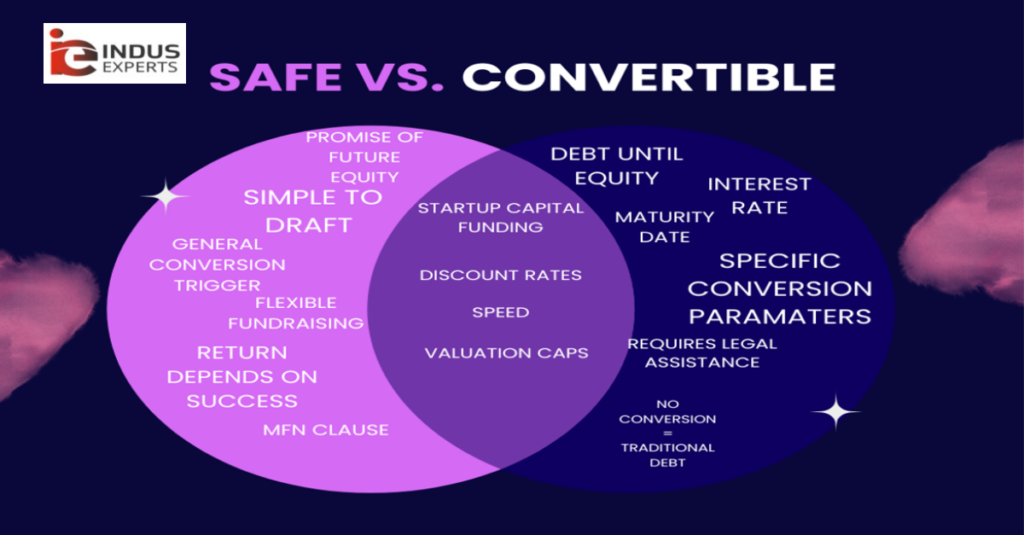
SAFE Notes vs Convertible Notes Explained
Raising early-stage funding is one of the biggest challenges for startups. In the early stages, founders and investors often struggle to agree on a company valuation because the business may still be developing its product, revenue model, or market traction. To solve this problem, startups commonly use funding instruments like SAFE Notes and Convertible Notes.
While both instruments allow startups to raise capital before a formal valuation is decided, they work differently in terms of structure, legal treatment, investor rights, and compliance obligations.
Professional firms like Indus Experts, operating in the professional services and financial consulting sector, help startups with fundraising structuring, governance, due diligence, legal compliance, corporate advisory, and investor readiness services.
What Is a SAFE Note?
A SAFE (Simple Agreement for Future Equity) is an agreement where an investor provides funding today in exchange for the right to receive equity shares in a future funding round.
SAFE notes were originally introduced by Y Combinator to simplify early-stage fundraising for startups. Unlike traditional debt instruments, SAFEs generally:
- Do not carry interest
- Usually do not have a maturity date
- Convert into equity during a future investment round
SAFE agreements are designed to make fundraising faster and founder-friendly.
What Is a Convertible Note?
A Convertible Note is a debt instrument that converts into equity during a future funding round. Investors lend money to the startup initially, and the amount later converts into shares based on agreed conditions.
Convertible notes generally include:
- Interest rate
- Maturity date
- Discount rate
- Valuation cap
- Conversion trigger events
Convertible notes are legally recognized funding instruments in India under specific regulatory frameworks.
SAFE Notes vs Convertible Notes — Key Differences
| Factor | SAFE Notes | Convertible Notes |
| Nature | Future equity agreement | Debt instrument |
| Interest | Usually none | Carries interest |
| Maturity Date | Usually no maturity | Fixed maturity period |
| Complexity | Simpler documentation | More structured and detailed |
| Investor Protection | Lower | Higher |
| Regulatory Recognition in India | Limited clarity | Legally recognized |
| Repayment Obligation | Generally no repayment | Repayment possible if conversion fails |
Why Startups Use These Instruments
Both SAFE Notes and Convertible Notes help startups:
- Raise funds quickly
- Delay valuation discussions
- Reduce initial legal complexity
- Access early-stage investors
- Close funding rounds faster
These instruments are especially useful for pre-seed and seed-stage startups where valuation is difficult to determine accurately.
Why Convertible Notes Are More Common in India
In India, SAFE Notes still operate in a legal grey area because Indian corporate and FEMA regulations do not explicitly recognize pure SAFE structures.
Convertible Notes, however, are recognized under Indian law for DPIIT-recognized startups, particularly when foreign investment is involved.
Under FEMA regulations:
- The startup must usually be DPIIT-recognized
- Investment thresholds apply
- Compliance filings are mandatory
This is why many Indian startups prefer:
- Convertible Notes
- CCPS
- SAFE-like hybrid structures
instead of traditional US-style SAFEs.
Common Mistakes Founders Make
Many startups create problems during fundraising because they:
- Use poorly drafted agreements
- Ignore FEMA and RBI compliance
- Fail to understand dilution impact
- Choose the wrong instrument structure
- Neglect investor rights and governance clauses
Founder communities and investors frequently discuss how improper note structuring creates legal and compliance complications during future funding rounds.
What Investors Usually Look For
Investors generally prefer funding instruments that provide:
- Legal clarity
- Defined conversion mechanisms
- Protection against excessive dilution
- Governance rights
- Compliance security
Strong documentation and structured governance significantly improve investor confidence during fundraising and due diligence.
How Indus Experts Assists Startups
Indus Experts helps startups and founders structure investment transactions through:
- Startup incorporation and structuring
- Fundraising compliance advisory
- Governance and due diligence support
- Legal documentation review
- FEMA and regulatory compliance
- Investor readiness services
- Risk assurance and transaction advisory
The firm combines expertise from Chartered Accountants, Company Secretaries, lawyers, and financial professionals to help startups raise capital while maintaining strong legal and compliance frameworks. (indusexperts.com)
Which One Should Founders Choose?
SAFE Notes May Be Better If:
- The startup operates in jurisdictions where SAFEs are widely recognized
- Founders want simpler fundraising documents
- Investors are comfortable with flexible structures
Convertible Notes May Be Better If:
- The startup operates in India
- Regulatory clarity is important
- Foreign investment is involved
- Investors require stronger legal protection
The choice ultimately depends on the startup’s jurisdiction, investor expectations, compliance requirements, and fundraising strategy.
Conclusion
SAFE Notes and Convertible Notes are both powerful early-stage fundraising tools, but founders must understand their legal, financial, and compliance implications before using them.
While SAFE Notes offer simplicity, Convertible Notes provide stronger regulatory recognition and investor protection, especially in India. Startups that carefully structure these instruments with professional guidance are better positioned for smooth fundraising and future growth.
With expert support from Indus Experts, startups can structure funding transactions properly, maintain compliance, and build stronger investor confidence during every stage of growth.