


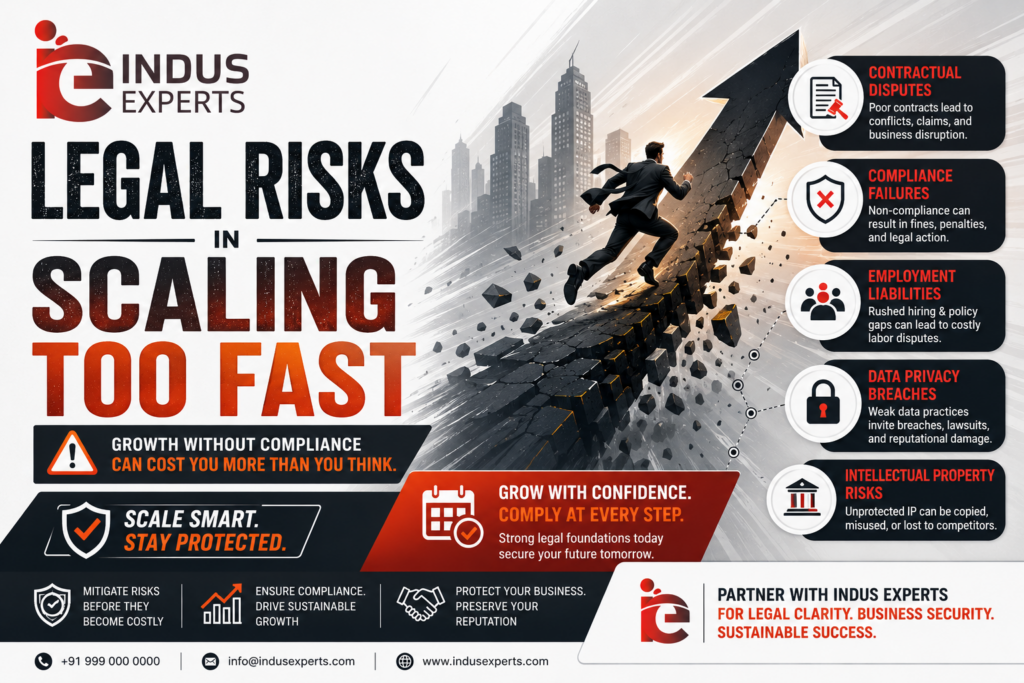
Legal Risks in Scaling Too Fast
For startups and growing businesses, rapid expansion is often seen as a sign of success. Increasing revenue, entering new markets, hiring aggressively, and raising investor capital can create excitement and momentum. However, scaling too fast without building a strong legal and compliance foundation can expose businesses to serious operational and financial risks.
Many companies focus entirely on growth while overlooking governance, documentation, regulatory compliance, and risk management. As a result, businesses that grow too quickly often face legal disputes, compliance failures, investor concerns, and operational instability. Sustainable growth requires not only ambition but also structured governance and legal preparedness.
Professional firms like Indus Experts, operating in the professional services and financial consulting sector, help startups and businesses manage corporate governance, compliance, due diligence, risk assurance, legal advisory, and global business structuring to support legally secure and sustainable growth.
Poor Compliance Management Creates Major Risks
As businesses scale, compliance obligations increase significantly. Companies must manage ROC filings, GST returns, tax reporting, labour law obligations, board meetings, statutory registers, and regulatory disclosures. Businesses growing too quickly often fail to establish proper internal compliance systems, resulting in missed deadlines and legal exposure.
Delayed compliance can lead to penalties, regulatory notices, director liability, and reputational damage. Investors also closely examine compliance records during fundraising and acquisitions. Poor compliance history immediately raises concerns about operational discipline and governance quality.
Indus Experts assists businesses through compliance management, corporate governance advisory, and secretarial services that help companies maintain strong regulatory discipline during expansion.
Weak Documentation Can Lead to Disputes
Rapidly growing startups frequently make important business decisions informally without proper legal documentation. This often creates disputes involving founders, employees, vendors, or investors later.
Common issues include:
- Missing shareholder agreements
- Poorly drafted contracts
- Unclear employment terms
- Improper ESOP documentation
- Incomplete board resolutions
As the business grows, these gaps become more dangerous and difficult to correct. Proper legal documentation protects businesses from future disputes and strengthens governance transparency.
Investor Confidence May Decline
Growth alone does not guarantee investor confidence. Investors want businesses that combine scalability with governance stability. During due diligence, investors carefully review:
- Legal documentation
- Compliance records
- Governance structures
- Financial reporting systems
- Internal controls
Companies that scale aggressively without proper governance systems often struggle during fundraising because investors view operational instability as a major risk.
Governance professionals consistently emphasize that strong governance frameworks improve investor confidence and long-term business credibility.
Employment and Labour Law Issues Increase
Fast-growing companies usually hire employees rapidly, but many fail to establish proper HR and labour compliance systems. Missing employment agreements, PF and ESI non-compliance, payroll irregularities, or unclear workplace policies can expose businesses to serious legal complications.
As teams expand across locations and jurisdictions, labour law compliance becomes increasingly important. Businesses that ignore these obligations may face employee disputes, penalties, and reputational damage.
Cross-Border Expansion Creates Additional Legal Complexity
Many startups expand internationally without fully understanding foreign regulations, tax structures, FEMA compliance, and international incorporation requirements. Improper structuring during global expansion can create tax inefficiencies, reporting violations, and regulatory scrutiny.
Indus Experts supports businesses through global incorporation, cross-border advisory, FEMA compliance, and international structuring services that help companies expand internationally with reduced legal risk.
Conclusion
Scaling a business quickly can create exciting growth opportunities, but expansion without strong legal and governance systems can become extremely risky. Poor compliance management, weak documentation, governance failures, and operational gaps can eventually damage investor confidence and business stability.
Sustainable growth requires businesses to balance expansion with compliance, governance, and risk management. Companies that build strong internal systems early are generally better prepared for fundraising, international expansion, and long-term success.
With expert guidance from Indus Experts, startups and growing businesses can strengthen governance structures, manage compliance efficiently, and scale with greater legal security and operational confidence.